
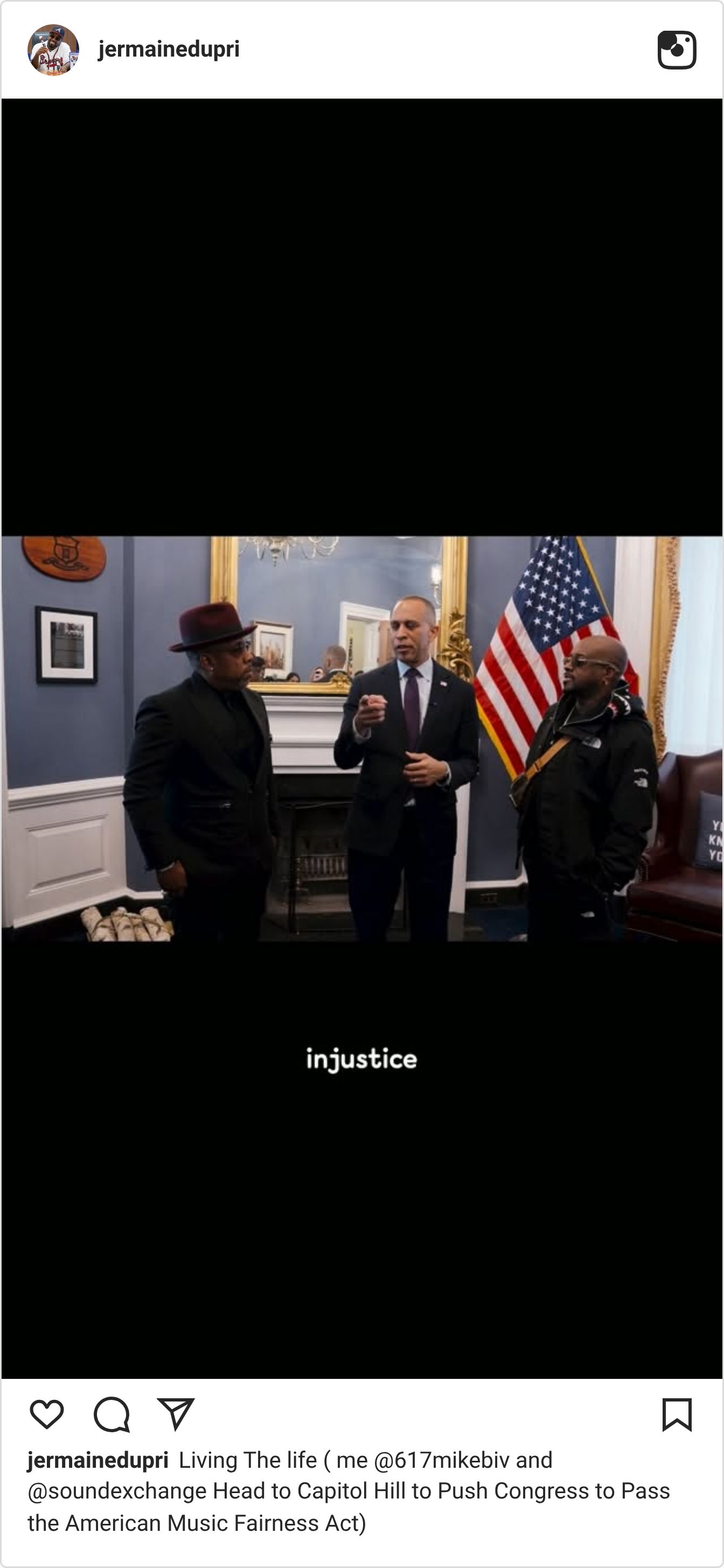
Music producer Jermaine Dupri and New Edition and Bell Biv DeVoe’s Michael Bivins were on Capitol Hill on Wednesday, pushing lawmakers to pass a bill that would require AM/FM radio stations to pay the artists whose songs they play.
We caught up with the two outside Sen. Cory Booker’s (D-N.J.) office, just before they headed in to lobby him on the American Music Fairness Act. Booker is one of the bill’s Senate cosponsors.
For anyone who needs a ’90s R&B refresher, Dupri founded So So Def, helped make Kris Kross famous and went on to work with Usher and Mariah Carey. Bivins is a founding member of New Edition and Bell Biv DeVoe and helped launch Boyz II Men.
Right now, AM/FM stations pay songwriters when their songs air, but not the artists who perform them. Streaming services already pay performers. Backers say the U.S. is the only democratic country that doesn't pay performers when their songs air on the radio.
“It’s a fairness act for performers’ music when the records are played on the radio,” Dupri told us. “I feel like it’s a bill that should have been passed years and years and years ago, and it’s still here.”
Dupri said artists are always chasing “their next check,” even when they’ve already made the hits.
“A lot of the rules, a lot of the things out here like this, that doesn’t just pay them outright,” he said.
“We have music on the radio,” Bivins told us. “When you hear your song on the radio, that’s a dinner, a celebration in your house.”
He noted that Frank Sinatra was pushing for the same thing decades ago, and not even Ol’ Blue Eyes managed to get it done.
“We just want our voice to be heard, just like the music is being heard. We just want to get compensated for it,” Bivins said.
Sinatra never got his wish, but the latest push has support from both parties. Sens. Marsha Blackburn (R-Tenn.), Alex Padilla (D-Calif.), Thom Tillis (R-N.C.) and Booker introduced it in the Senate in January 2025, and Rep. Darrell Issa (R-Calif.) is leading the House version. The bill also includes a break for smaller stations: Those making less than $1.5 million a year could play unlimited music for under $500 annually.
Broadcasters aren’t sold. The National Association of Broadcasters has opposed the idea for years, arguing that free airplay is valuable promotion for artists and that new fees would hurt local stations.
Booker was the pair’s first meeting of the day, so we got them before any lawmakers did.
“You’ll be our prelude into that conversation,” Bivins said. “So you get us fresh, fresh off the airplane, fresh from the hotel.”
Later that day, they also met with House Minority Leader Hakeem Jeffries (D-N.Y.), who had won overwhelming support from his caucus to become the next speaker just hours earlier.
We asked what they wanted Congress to do next.
“Sign. Yes, sign it,” Dupri said.


